Blog post originally written by the AllStripes community team. AllStripes was acquired by PicnicHealth in 2023.
To listen to the recording of this conversation, click here. The full transcript is below.
MUBINA: I went to a PSP support group, out in the middle of nowhere in New Jersey when I first found out my mom had this. There was only one other participant in the support group, and that person was there because they thought the meeting was about PSP — the Play Station.
That was my first experience with people not understanding what PSP is. I mean, even amongst my interactions with medical staff — they’re very not familiar with what it is. I’ve had doctors actually google it in front of me.
JOSÉ: This conversation was produced by AllStripes, the leading research platform designed specifically for rare diseases. It’s part of our content series spotlighting stories from the rare community.
MUBINA: My name is Mubina Khan Schroeder. I am a born-and-raised New Yorker and I live in New York City currently.
SYLVIA: My name is Sylvia Rupani-Smith. I live in Brooklyn.
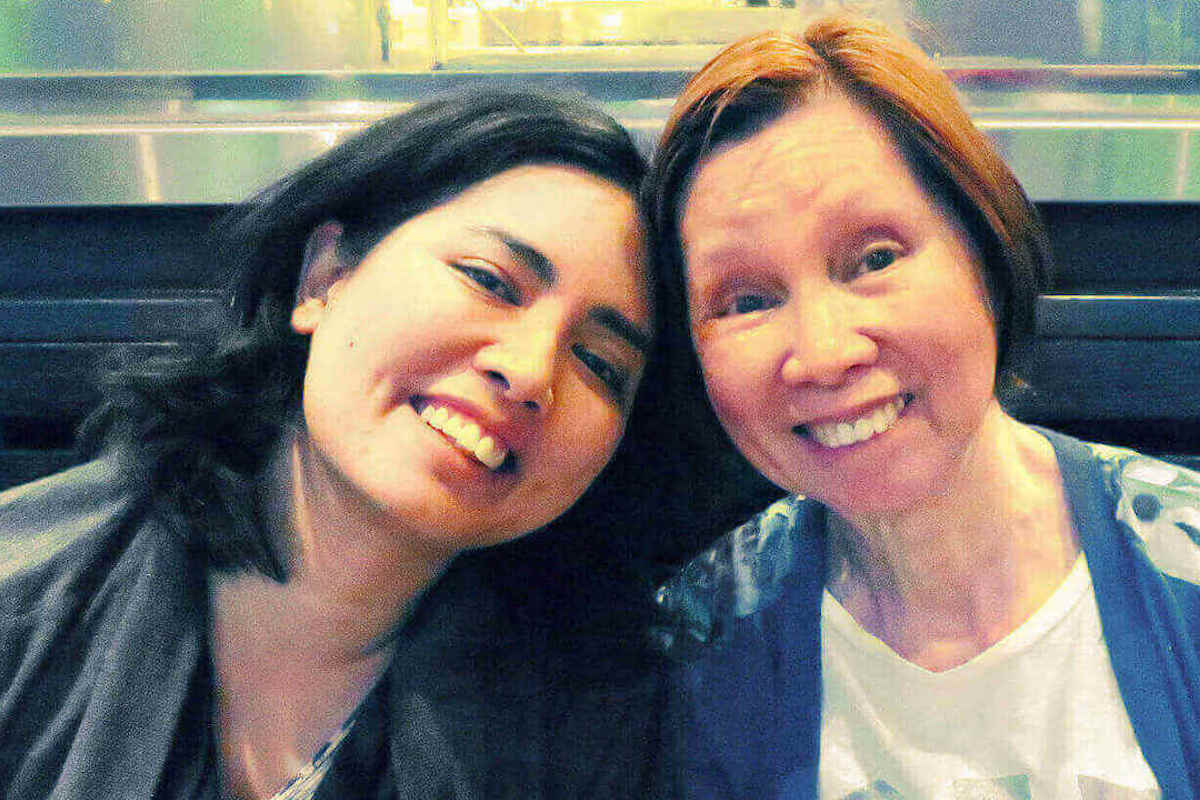
JOSÉ: Mubina and Sylvia met because of their mothers, who were both diagnosed with progressive supranuclear palsy and eventually passed away from complications of the disease. This past summer, they spoke with AllStripes about their experiences.
Sylvia and Mubina told us that because PSP is rare, their families’ experiences were isolating at times — and that they would have felt even more lost without each other. They describe how their relationship began with a clipboard and the New York Times, what it was like to watch their very independent mothers change and share advice for people caring for loved ones with progressive diseases like PSP.
MUBINA: I try to explain it in terms of its symptoms. I call it a brain disease and I describe it in terms of how debilitating it is and how it’s progressive. Progressive is in fact a part of its name — progressive supranuclear palsy. And unfortunately, it progresses to the point where the patient passes away. Oftentimes people don’t understand what the disease looks like.
JOSÉ: Like Mubina says, PSP is a brain disease. It’s a rare degenerative neurological condition that, at first, primarily affects balance and eye movement. As PSP progresses, it can also affect eating and swallowing, speech, cognitive ability and mood. The onset of symptoms usually happens around age 60, but can sometimes begin earlier. Mubina’s mother began to show symptoms when she was in her mid-60s.
MUBINA: My mother, her name was Shahjahan, she was named after the king who built the Taj Mahal. And apparently she gave herself that name because she liked it so much. She was my best friend — so I knew her very well. I’m her only child and we were exceptionally close.
In 2006, I started noticing some slight behavior changes. She became a backseat driver. She would always be driving with me and would start saying like, you shouldn’t go here. You should go here. It was very out of character for her.
She went to visit this herbal doctor and gave him $30,000, which was something that she would never have done. She used to be an educator in the New York City public school system. She was a math expert — you know, so it was very odd that she did something like that. I found a diary entry from her, around 2007, and all it says is, Things are changing.
JOSÉ: It took more than seven years and 19 different doctors and neurologists before Shahjahan was diagnosed with PSP. Like Mubina, Sylvia was very close with her mother, Betty. In 2011 Betty started falling without much explanation. Her PSP diagnosis came about two years later.
SYLVIA: My mother was diagnosed in 2013 at Beth Israel Hospital by a Dr. Rivka Sachdev, who was able to see her symptoms right away as PSP. Prior to that, my mom, she was very independent. She actually lived most of her life in Japan, she met my father there, and she would bicycle everywhere and, you know, do all kinds of things by herself. But we noticed from time to time that she had a tendency to fall, and then they just started to progress a little, in terms of the falling. We were very worried because we just didn’t know how often she would end up falling.
Like Mubina’s mom, she refused to believe this was happening to her. She was such an independent person, not needing anyone’s help, took care of five children on her own. She just couldn’t believe it.
MUBINA: Shortly after I learned that my mom had PSP, the CurePSP Foundation, which is a pretty incredible foundation in terms of the research that they fund and the resources that they offer to families affected by PSP. They have an annual conference, and it happened to be in New York, in Queens of all places. And I was like, oh my gosh, this annual conference is in a few days. And it’s only two minutes away from my house.
On one of the days, there were presentations by scientists on, you know, research with PSP. And I thought, you know what? This is really great, but I’d love to network with other people who are dealing with PSP.
So I got out this little clipboard and I wrote on it. Hi, my mom has PSP. I’d love to meet people who also are affected by PSP and be friends with them. Please put your name and contact information on here if you’re interested in keeping in touch. And I started passing it around and the first person I passed it to was this young lady who was sitting to my left at a table by herself. And I said, oh, she looks friendly. And that was Sylvia.
SYLVIA: It was quite a large room full of people. So I was a little astonished to be honest that all these people were curious to know about PSP or had some relationship to it, honestly. I was really relieved that Mubina had provided me her contact information so that we could talk to each other.
MUBINA: She wrote her name down and a few weeks later she contacted me. I was actually in the hospital with my mother when she contacted me. And she told me she was writing an article for the New York Times about PSP and that her mother too also had PSP. It was such an emotional conversation that I think that just forged this bond between us that’s continued to this day.
SYLVIA: Once we formed this bond we pretty much were each other’s lifelines. Honestly, I don’t know how I could have survived this whole thing without Mubina. I really needed someone who really understood what we were going through.
MUBINA: Having someone that you can just text and say, this is a bad day, it was really, really wonderful.
JOSÉ: Sylvia quoted Mubina in her article for the New York Times, which is called “The Falls Were Bad. The Diagnosis Was Worse.” And the two kept in touch, texting and calling each other more frequently as their mothers’ conditions progressed.
MUBINA: Most of the things were tragic, but sometimes things were funny.
Sylvia, I think I called you when I was in Bellevue Hospital once. I was always putting on TV for my mom because she couldn’t do much else than watch television at some point.
SYLVIA: Right.
MUBINA: And she would complain to me about the shows that I was picking for her. And she said something to me about how I thought that she wasn’t smart enough to watch the shows that she liked. And it was just — it was funny because I was picking childlike shows for her to watch.
SYLVIA: I think what was really helpful to us both was you know, we were in it together. I feel like I might’ve alluded more than once to just wanting to escape the whole thing. And there was some humor in that too, because we all knew we couldn’t run away from what we were dealing with. But it felt kind of like the one relief we had was even the slight prospect of leaving it all behind. I felt like that was helpful. There was some beautifulness in that.
JOSÉ: Both Mubina and Sylvia told us that they continued to see flashes of personality throughout their mothers’ illness, even toward the end.
My sister, Saya, who was taking care of my mom, was attempting a yoga pose in front of my mom. And my mom couldn’t move very much, but she found a way to actually use her leg to kick my sister as a means of like, “Hey, I’m still here. I still have a sense of humor and I’m going to totally mess with your balance right now.” And she shared that at the eulogy. And I was like, “Oh, that’s, that’s my mom. That’s the mom I know and love who was probably the naughtiest person in her high school.”
JOSÉ: In 2018, Shahjahan passed away from complications of PSP, followed by Betty’s passing one year later. We asked Sylvia and Mubina what advice they had for anyone with a loved one currently facing a PSP diagnosis.
MUBINA: You know, doctors, nurses, hospitals, they didn’t really know what to do with my mom. They couldn’t really tell me what to predict. (This was where I found Facebook support groups to be super helpful.) To people who might be dealing with this, I would say, first of all, you should really get all of your logistical stuff in order. Talk to the patient while they’re still able to verbalize and communicate their wishes.
For example, we talked to my mother and she said she did not want a feeding tube. I explained to her what it was and the doctor explained it to her, because this was actually at a doctor’s visit. And she adamantly said, “No, I don’t want that.” So that was important for me. Because when it got to that point, I was thinking about giving her a feeding tube. But I remembered that she was very adamant that she didn’t want that intervention.
SYLVIA: For those who caregive, it’s so overwhelming. You really have to adhere to the caregiver’s mantra. It’s one day at a time it’s one hour, it’s one minute, find that peace. And I guess, especially because it is someone you love, you have to remember what you’re doing this for, but you know, in the long haul, you still have to take care of yourself.
MUBINA: One thing I wanted to mention to people who are dealing with patients or loved ones with these sort of devastating illnesses, is to always remind yourself to respect the patient and to love them. Because for example, my mom couldn’t communicate, sometimes I would assume that she wasn’t there, that she was gone, but then I would have reminders that she still understood everything.
I remember we were in a doctor’s office once and he was talking about how she would probably have pneumonia and that might be the way that she passes away. And my mom started actually tearing up. She couldn’t speak, but tears started rolling down her face. So she understood everything.
You know, so just — when you’re caregiving it’s often easy to get caught up in all of the caregiving things that you’re doing. But to remember that you’re still dealing with a loved one who’s very much human, who might very much need talking to, or just even handholding or attention to their feelings. It’s hard to remember that. And I hope that people do remember that because it’s so crucial.
SYLVIA: Yeah, that’s so essential. I agree, you’re so right. I mean, that’s the thing about PSP: they could understand everything, they just couldn’t do anything about it. So I think that is really the most essential thing is to make sure that you’re doing what your mom or your patient wants and doing what is best for them.
JOSÉ: You can learn more about AllStripes by visiting allstripes.com. This conversation was edited and narrated by me, José Vadi, and produced by Sylvia Rupani-Smith, Mubina Khan Schroeder and Jen Gann. It’s dedicated to the memory of two very independent women: Betty and Shahjahan.
AllStripes’ research programs are open to legally eligible families who want to contribute the medical history of a loved one who has passed away. Contributing records on behalf of a loved one who has passed away can create a meaningful legacy and provide valuable information to improve the lives of patients and their families for generations to come.
We know that every person's story is unique and deserves to be heard.
Join our early breast cancer registry to be counted and share your story with research.
List the names of all the doctors, hospitals, and other facilities your loved one visits regularly, along with those they have visited in the past. Try to go back as far as you can, striving for at least the last 5-10 years, but do your best. Even if you can’t remember them all, having a strong baseline can help you quickly identify gaps in records.
Ensure You Have the Appropriate Legal Status
It is important to make sure that you are fully empowered to make decisions on behalf of your loved one with Alzheimer’s. Your relationship status with the patient may not be enough to legally give you access to your loved one's medical information. It is a good idea to talk to an expert about securing special legal status, such as Power of Attorney (POA), a legal document that allows an individual to name someone as their decision maker should they no longer be able to make decisions on their own.
Gather and Organize the Medical Records in One Place
It’s important to have all of your loved one’s medical records together in one spot. This makes it much easier for you and your loved one’s physicians to accurately map the patient’s medical journey and more easily share information between doctors. Fortunately, tools exist to make record management and access simple. A free resource like PicnicHealth helps you collect and organize all of this information. PicnicHealth’s intuitive timeline allows you to pinpoint data across the medical history, eliminating your need for keeping heavy binders filled with paper records or keeping track of multiple software portal logins.
Review the Medical Records to be an Informed Advocate
The better you understand your loved one's medical history, the better you can advocate on their behalf. Access and understanding of this information will help you to ask informed questions with physicians. Through regular communication backed by the data in the medical records, you can help your loved one’s care team develop a more successful care plan.
Learn more about PicnicHealth’s commitment to the Alzheimer’s community and the Alzheimer’s Association
When you’re juggling appointment times and insurance claims, putting a robust support system together might not strike you as the most urgent task. Investing the time to cultivate relationships with people can turn to in times of need will pay dividends. The next time you need a last-minute ride or just someone to listen, you won’t be on your own. There are many condition-specific support groups and support groups for caregivers generally in person or online. In addition to the encouragement and empathy they provide, support groups can be a helpful source of tips, resources, and recommendations for navigating caregiving.
2. Stay organized.
The backbone of effective caregiving is organization. Keep medical information, appointment schedules, and medication lists in order. Use a planner or a digital service like PicnicHealth to stay on top of your responsibilities. This attention to detail can prevent future complications and reduce day-to-day stress.
3. Explore treatments and clinical trials.
We’ve seen incredible breakthroughs in treatment over the past couple of years, powered by patients and their caregivers participating in research. Stay in the loop about the latest in medical advancements and available resources that could benefit your loved one. Whether it’s a new therapy option or a community service that aids independence, being informed can make a world of difference in the quality of care you provide.
4. Make time for self-care.
It may seem self-centered to focus on self-care—but when you feel good, you can be a better caregiver. Whether it’s exercise, a mindfulness practice, a soak in the bath, or just time to rest when you need it, carve out those moments in the day when you can unwind, reset, and stay healthy mentally and physically. Think of it as building up your reserves of kindness, patience, and understanding—which can only benefit your loved one. No one can pour from an empty cup.
Having trouble managing your loved one's medical records?
Easily manage all of your loved one's medical records and contribute to ongoing Alzheimer's research with PicnicHealth.
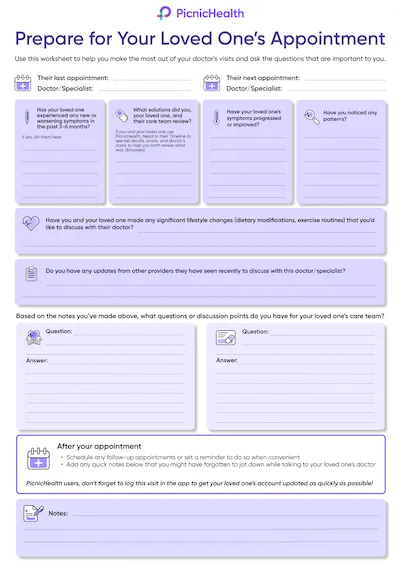
Tip: Download or print the poster at the end of this article to review before your next appointment!
However, it's important to consult with a healthcare provider or registered dietitian to determine the appropriate amount of protein for your individual needs. In general, a diet with moderate protein intake (about 0.8 grams per kilogram of body weight per day) is recommended for people with kidney diseases.
Learn more about contributing to IgAN research with PicnicHealth.
A tablet, phone, or laptop with a working camera, microphone, and stable internet connection.
A quiet, distraction-free area with enough space to walk a few steps if applicable.
A chair that you can use during any movements or tasks you’ll be asked to perform.
The tripod mailed to you via Amazon.
What to Expect
Before your video call:
Book Your Assessment
Visit your to-do list on your PicnicHealth Research Dashboard or click the scheduling link sent to your email. Note: Search for “New task for the ORBIT-CIDP Study" to find the video call scheduling link.
Receive Confirmation
Check your email for a confirmation with your scheduled video call time and instructions.
On the day of your video call:
Click on Video Link
Join your personal video call using the link we sent by email, or text message, or find it on your research dashboard.
Meet your nurse
A Registered Nurse (RN) will guide your virtual assessment, which will last about 30 minutes.
Complete the Physical Activity Assessment (INCAT)
The nurse will guide you through questions and, if needed, physical tasks to help researchers gain a deeper understanding of CIDP.
Complete the Movement Assessment (Optional)
If you participate, a nurse will guide you through three short recorded movement activities to complete as best you can:
Chair Task
While seated with your arms crossed over your chest and hands on oppositeshoulders, you’ll be asked to stand up, remain standing for 20 seconds, and then sit back down.
Arm Movement Task
While seated with your arms resting at your sides, you’ll be asked to raise both arms out to the sides until they meet above your head, then lower them back to your lap.
Finger Dexterity Task
While seated, raise your right hand with fingers extended. Touch your thumb to each fingertip in order, then reverse. Repeat with your left hand. This will then be repeated with your left hand.
Earn Compensation
Receive up to $55 for your participation:
$25 for completing the Physical Activity Assessment (INCAT).
$30 for the Optional Movement Assessment.
Recording: Your research assessment may be recorded to ensure accurate data collection. If you participate in the optional Movement Assessment, it will also be recorded. These recordings may capture your voice and responses, but identifiable information like your face, name, or background will be removed to protect your privacy.
Opt Into the Smart Insole Study Activity
Complete the opt-in survey to confirm your participation.
Receive Your Smart Insoles
Your smart insoles will be shipped to your home via FedEx and should arrive within 1 week.
Create Your Account
You’ll receive an email from Celestra Health with your account details. Follow those steps to set up your account.
If you don’t see an email from Celestra Health in your inbox, please check your spam or junk folder.
Download the App
After creating your account, you’ll be directed to a landing page with links to the App Store or Google Play. Use the link to download the correct version of the app for your device.
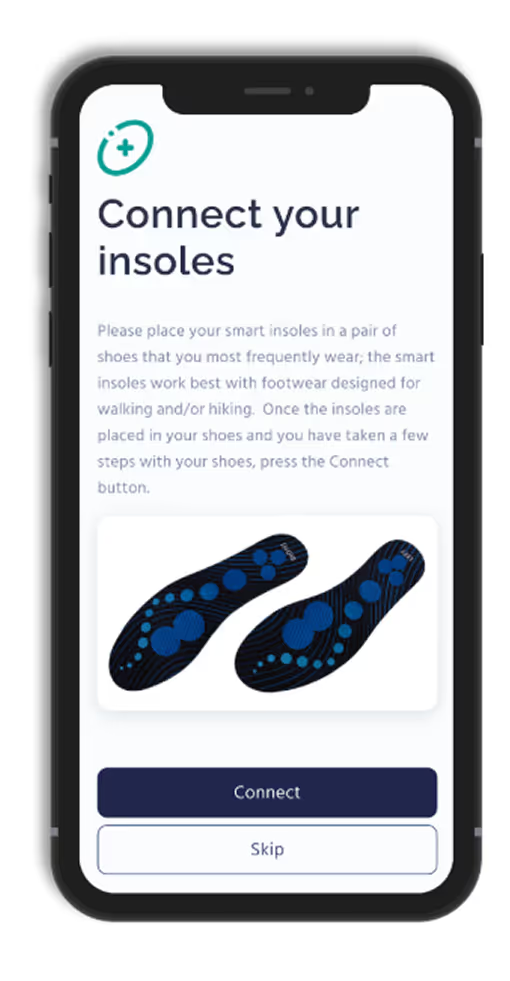
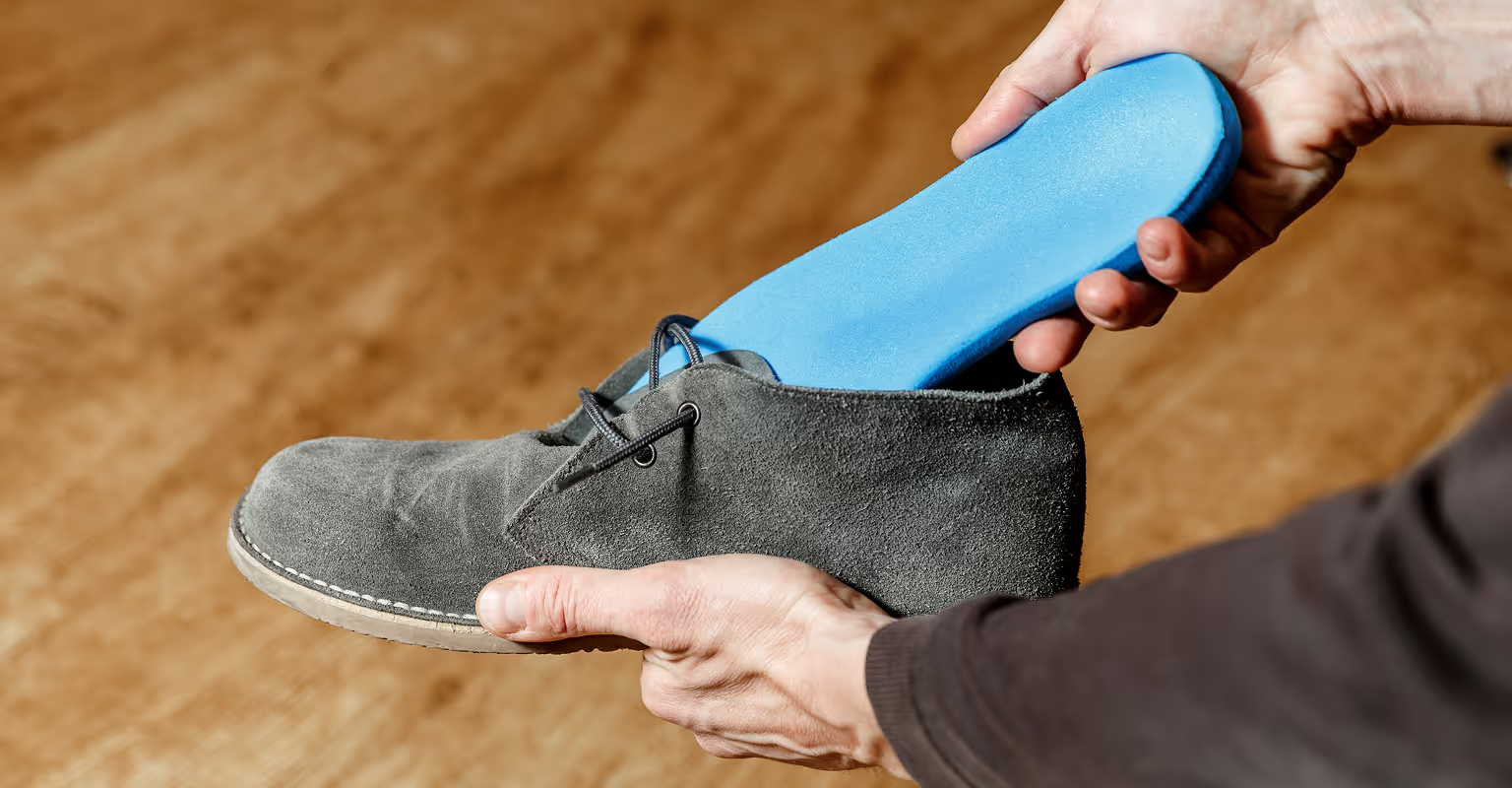
For illustrative purposes only, your insoles may look different
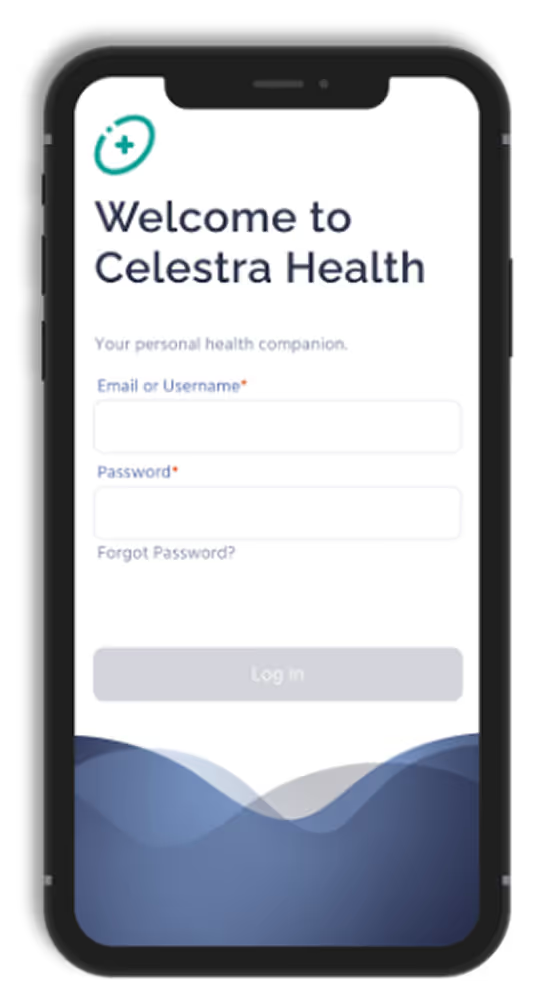
Log In
Open the app and log in using the email address and password you used when creating your account.
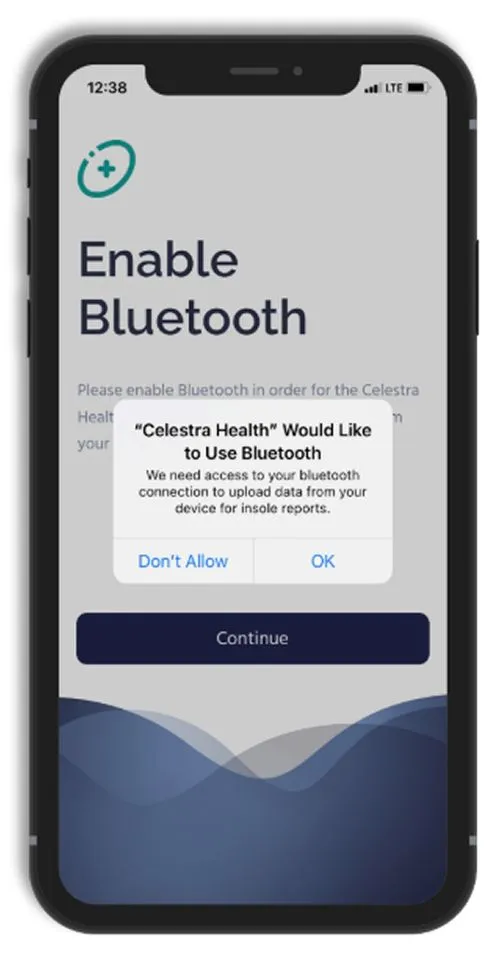
Enable Permissions
For iOS users: Enable Motion & Fitness and allow access to Apple Health.
For Android users: Enable Activity Recognition permissions.
Connect Your Insoles
Turn on Bluetooth, and follow the app's instructions to connect your smart insoles.
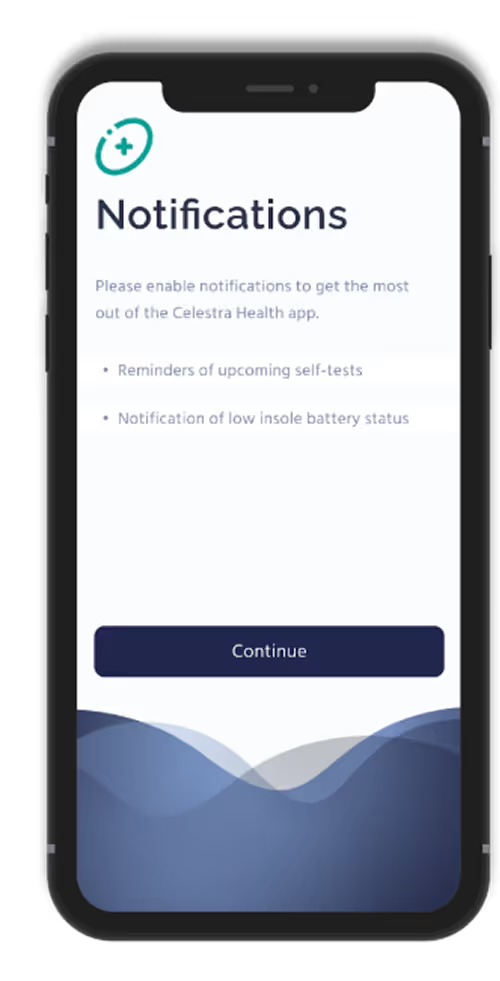
Enable Notifications
Enable push notifications to stay updated on reminders and activity progress.
For illustrative purposes only, your insoles may look different
Start Walking Sessions
When you’re ready to perform a walking session, tap ‘Start’ on the Ad Hoc Walking task card in the app.
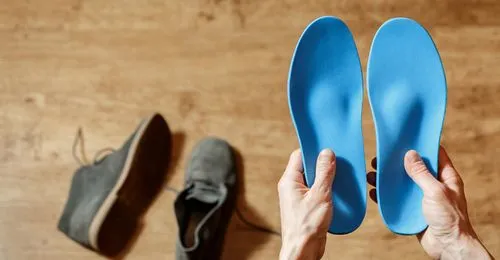
Smart insoles are designed to fit comfortably into any pair of closed shoes
Need Help?
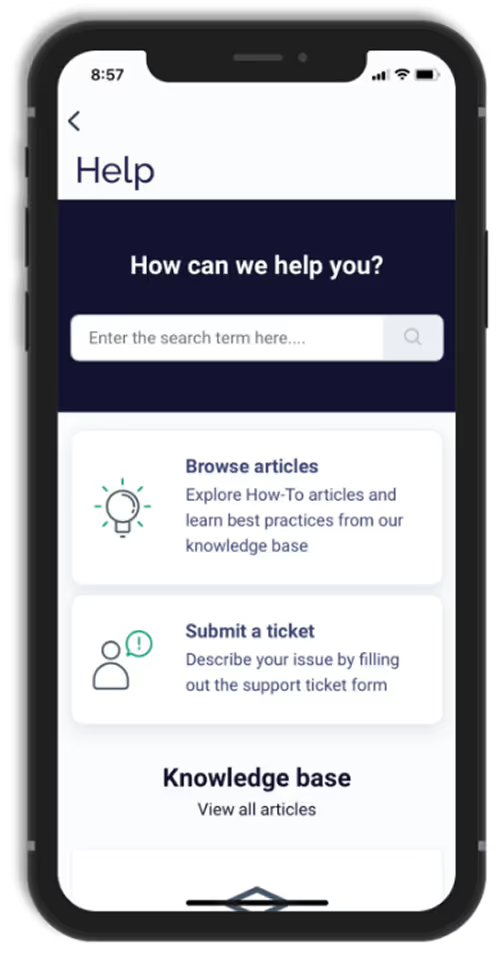
Should you need to contact Celestra Health support for any reason, you can submit a ticket through the Help section of the app by tapping the Submit A Ticket card and filling out the form. A Celestra Health representative will typically respond within one business day.
A fully charged device (smartphone, tablet, or laptop) with a working camera, microphone, and stable internet connection.
A quiet, well-lit space that is free from distractions.
Good lighting so your face is clearly visible; having a small flashlight or your phone’s flashlight nearby can help with skin, scalp, or joint checks.
Flexible device positioning so you can easily adjust or prop up your device hands-free if the research staff asks to view specific areas (such as your face, hands, or scalp).
Space to move in case you are briefly asked to stand or walk a few steps.
Your medication information, including your current steroid(s) and BENLYSTA® (belimumab) — either the medication bottles or a list with doses and schedule.
Time to focus without interruptions so the visit can be completed comfortably.
Before Your Video Call:
Schedule your visit
Use the scheduling link on your PicnicHealth Research Dashboard or the link sent to your email. Tip: Search your inbox for “New task for the BEACON-SLE Study - schedule your remote visit” to find the scheduling email.
Check your confirmation
You’ll receive an email with your appointment time and instructions for joining the video call.
On the Day of Your Video Call:
Join the call
Click the Zoom link sent to you by email or text message, or use the link available on your research dashboard.
Meet with the research staff member
They will ask you structured questions about your health and any lupus symptoms you’ve experienced over the past 30 days.
If needed, they may guide you through a few simple visual checks (such as looking at your skin, hair, joints, or mouth). You can always tell them if you’re not comfortable with anything.
Receive Compensation
You’ll receive up to $60 for completing your visit.
A fully charged device (smartphone, tablet, or laptop) with a working camera, microphone, and stable internet connection.
Prop your device on a table or stable surface so it faces you at eye level if possible.
A quiet space that is free from distractions.
Time to focus without interruptions so the visit can be completed comfortably.
What to Expect
Before your interview:
Schedule your interview
Use the scheduling link on your PicnicHealth Research Dashboard or the link sent to your email.
Tip: Search your inbox for “NAVIGATE-CIDP Interview” to find the scheduling email.
Check your confirmation
You’ll receive an email with your interview time and instructions for joining the call.
On the day of your interview
Join the call
Click the Zoom link sent to you by email or text message, or use the link available on your PicnicHealth Research Dashboard.
Meet with the research staff member
The conversation will cover your CIDP journey and treatment experiences. There are no right or wrong answers — your perspective is what matters.
Ask for your permission to audio-record the session. Recording helps us accurately capture what you share. If you’d rather not be recorded, just say so — we’ll take notes instead, and it won’t change anything about your participation.
Receive compensation
You’ll receive $150 for completing your visit. Available to claim in the Rewards section of your PicnicHealth account after your interview.
A few things to know: Take your time. There’s no rush. Pauses and silence are completely fine.Skip anything you’d rather not answer. Just say so, and your interviewer will move on.Ask for clarification if a question isn’t clear. Your interviewer is happy to rephrase.Take a break if you need one. Just let your interviewer know.
Stop at any time if you want to end early. There’s no expectation either way.
Need Help?
If you have questions before, during, or after your interview, we’re here.
Walking through life with salt-wasting congenital adrenal hyperplasia (CAH) brings its own set of ups and downs. For Taylor and her son, Maddox, it’s a path marked by sudden storms and sunny days, a mix of medical emergencies and moments of pure childhood joy. Here’s their story, told with the warmth and honesty that Taylor brings to every conversation.
In celebration of Rare Disease Month, we are thrilled to shine a spotlight on Change Champions, dedicated partners, and organizations making a lasting impact on rare disease research throughout the year. At the forefront of this movement is Rare Patient Voice, a remarkable resource founded with a singular mission – to provide patients and family caregivers a platform to be heard by actively participating in diverse research endeavors, including rare diseases.